Get Me Bodied

Recently, I attended a surprise birthday party and over the speakers, I heard a melody
that was vaguely familiar.  Beyonce was singing Get Me Bodied.  Apparently the song had been released a few years ago, but I didn’t take notice of it at that time.  At its most basic level, Get Me Bodied is an infectious dance song, so I could leave it at that. But I won’t, mostly because I’m on a quest to feel more aware of and at home in my own body.  As easy as Bey makes it look (at least in the video), walking in the psalmist’s declaration of being fearfully and wonderfully made often takes some soul work.

I have fond memories of family gatherings when I was a child and much less self-conscious.   We would get together and do the Bump and the Bus Stop.  (Yes, I’m dating myself.) And when the Jackson Five’s Dancing Machine came on, all of us kids stopped what we were doing and started in on the Robot. Every year around this time, I enjoy my ritual of watching the dance scene from A Charlie Brown Christmas. When I watch those lovable characters in the Peanuts gang, I am struck by their exuberance and their comfort with moving in their own rhythms.  Some are on beat; others are off.  None of them care one way or the other.  All of them are having a great time.

As I strive to befriend my body, things get complicated when it doesn’t cooperate.  While I feel blessed to be relatively healthy, I do have some issues that give me pause and remind me of the need to be vigilant.  What happens when your body seems to turn against you?  An OB/GYN answered this question in a revolutionary way right before she had a double mastectomy.  I looked at her video again and remembered where I heard Get Me Bodied before.

Sometimes I wonder how Jesus experienced his own body, especially before his public ministry.  Did he ever feel unattractive or awkward as a teenager?  Did he get sick or have to watch sick people suffer and die?  If he did, perhaps he recalled a previous conversation that he had in another space in eternity.  A conversation amidst the Holy Trinity’s lament over a fallen world where he spoke up and said “Get Me Bodied.”  Actually, he hasn’t stopped saying it. He continues to say it to you and me.

In the beginning was the Word, and the Word was with God, and the Word was God. The Word became flesh and made his dwelling among us. We have seen his glory, the glory of the one and only Son, who came from the Father, full of grace and truth.  John 1:1,14 (NIV)

 Your Call: Take some time to watch the videos.  How do they make you feel?  How would you describe your relationship with your body?  In what sense might Jesus be telling you “Get Me Bodied?”

The Awakening: When Gratitude and Desire Meet

Advent1Somewhere between already and not yet, I’ve thought about what it looks like to be thankful in the midst of longing. So how does a holiday defined by gratitude end up so close to a season based on waiting for the fulfillment of Promise?  Is there is a reason why Advent arrives so soon after Thanksgiving? Can gratitude and desire co-exist?  I think so. In fact, I hope that they do more than co-exist. I want them to become friends.

By pointing out what is good in my life and in the world, gratitude can lead us to a place of rest as we recall the faithfulness of God in times past.    It nudges us when tempted to sleepwalk through life in perpetual daydreams of what could be.  Gratitude grounds us in the moment, encouraging us to be fully present in it.   Then, desire brings balance. It speaks of possibility, and doesn’t allow for complacency with what is, but invites us to answer Jesus (honestly) when he asks “What do you want?” Recognizing desire can alert us to needs and issues that are both within and around us, all the while stirring us to action.

I look forward to seeing how gratitude and desire will connect in my life over the next month.  In the meantime, it is my prayer that this Advent season awakens you to the presence of Christ and his purpose for your life in a world in much need of love, hope, and justice.

And do this, understanding the present time: The hour has already come for you to wake up from your slumber, because our salvation is nearer now than when we first believed. Romans 13:11 (NIV)

Your Call: In what area(s) of your life do you need to be more fully awake?  If gratitude and desire had a conversation regarding your life at the moment, what would it sound like? 

Despising the Shame: The Power of Vulnerability

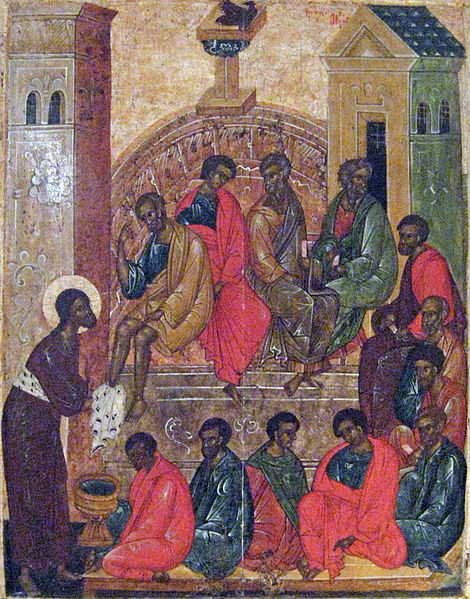
470px-Omovenie_nog“…looking to Jesus, the founder and perfecter of our faith, who for the joy that was set before him endured the cross, despising the shame, and is seated at the right hand of the throne of God.”  Hebrews 12:2  (ESV)

About 25 years ago, I participated in a foot-washing service on Maundy Thursday for the first (and last) time.  I don’t remember much about it, except how exposed I felt while having my feet washed.  If Jesus were to show up with basin and towel in hand as I arrived home from work, I would be tempted to dash out for a quick pedi, or at least sneak upstairs for some cocoa butter.

Foot washing is an intimate act, as demonstrated by the Pope this week. It sheds light on tender places, hidden aches and rough spots that come when the walk gets weary.

Vulnerability makes me nervous, but there’s no true intimacy without it. It’s the vulnerability of Jesus that has beckoned me during this Holy Week.

Anointed for his burial by Mary of Bethany as she wipes his feet with her hair.

Wrestling with his Father’s will at Gethsemane.

Hanging from a cross, beaten, bloodied and stripped naked. 

Crying out “My God, My God, why have you forsaken me?”

Vulnerable, yet despising the shame.  I would like to think that during these moments, Jesus called to mind that Voice which said, “This is My Beloved Son.”

So I will remind myself that I am a Beloved Daughter, despising any shame that would hinder my journey. I will sit down and take off my shoes and soak my feet in Living Water. I will let the vulnerability of these moments usher me into Resurrection.

Your Call:  Are there areas of shame that hinder the authenticity, vulnerability and intimacy necessary for resurrection in your life?  If so, begin to bring them into the presence of Christ.

Advent Reflections: Veni Emmanuel

candle

Oh come, Oh come Emmanuel
And ransom captive Israel
That mourns in lonely exile here
Until the Son of God appear.*

In lonely exile like:

panhandlers desperate for food and dignity;
immigrants isolated in culture and language;
the fearful and the awkward, simply trying to find their place;
those wrestling with voices that insist that this is all there is;
those discarded, oppressed or silenced.

May it be that we make room
for hope,
for the Son of God to appear
with us,
in us,
through us.

Veni Emmanuel.

Amen.

(*From the English translation of the Latin hymn “Veni, Veni Emmanuel.”)

Your Call:  Recall a time in your life when you have “mourned in lonely exile”; pray for those who find themselves there now. Consider how you can make more room for the Son of God to appear in your life.

Breaking Bread: The Power of Conversation and Community

Now that same day two of them were going to a village called Emmaus, about seven miles from Jerusalem. They were talking with each other about everything that had happened. As they talked and discussed these things with each other, Jesus himself came up and walked along with them;but they were kept from recognizing him. He asked them, “What are you discussing together as you walk along?”  They stood still, their faces downcast.
Luke 24:13-17 (NIV)

It has been months since Easter Sunday, but I still find myself captivated by the disciples’ trip to Emmaus. I can imagine their state of mind. Perplexed. Expectations dashed. “We had hoped that [Jesus] was the one to redeem Israel,” said the disciples to the Stranger who had joined them on the journey.

Last weekend, I attended a women’s conference that revived me in a way that I had not experienced in a while.  It was as if the wind of the Spirit blew into my soul afresh, and I rejoice in a renewed sense of purpose and potential.  Yet a week later, I find myself overwhelmed as I discern what my next steps should be. After these mountaintop experiences, my challenge is always to maintain momentum when I get back to sea level. In the meantime, I grieve recent tragedies such as the shooting in Aurora, CO. I recognize that in the shadow of the resurrection, death remains. The death of loved ones. The death of dreams. The death of relationships.

“We had hoped that…”

I can relate.  Don’t we all have those thoughts, those if-onlys, haunting us from time to time? I had hoped that my father would live to see certain milestones in my life.  Parents of the victims in Aurora had hoped to see their children thrive.

As they approached the village to which they were going, Jesus continued on as if he were going farther. But they urged him strongly, “Stay with us, for it is nearly evening; the day is almost over.” So he went in to stay with them. When he was at the table with them, he took bread, gave thanks, broke it and began to give it to them. Then their eyes were opened and they recognized him, and he disappeared from their sight. They asked each other, “Were not our hearts burning within us while he talked with us on the road and opened the Scriptures to us?”   Luke 24:28-32 (NIV)

There was something about this Stranger who entered into conversation and community with the disciples.  He inquired. He listened. He brought clarity. He challenged. He blessed. He broke bread.  And all of a sudden, the disciples knew that the “rumor” was true.  Jesus was alive and sitting right there in front of them!

Lately, I’ve asked myself, “when was the last time my heart burned within me, in a good way, based on a conversation?”  By conversation, I do not mean hearing from the Lord through sermons or personal prayer times, though these are vital practices for me.  What I mean is talking with others. I realize that conversations can get a bit messy. After all, Jesus broke the bread; he didn’t slice it.  The good news is that the Presence of Christ can show up in the midst, messiness and all.  Plus, there’s a heartiness and substance to bread that is broken compared to the neatly sliced bread that I often buy at the supermarket.

I’m starting to ask myself a lot more questions to help me envision what “breaking bread” really means.  Please join me.

What if we were more intentional about reminding each other that Jesus is alive and that we can live out that truth between Sundays, conferences, retreats and revivals?

What if we spoke life into desolate places in each other and in the world around us? 

What if we agreed with God that death, while present, does not have the final say? 

What if we not only grieved for families of victims in Aurora, but also confronted the culture of violence in the United States?  

What if we invited the “voiceless” into the conversation? 

How is God calling us to represent the resurrection of Christ in the world?

Your Call:  Read Luke 24:1-35; what stands out to you about the journey to Emmaus?  What is the role of conversation and community in your life? 

Manna for Lent

Beloved Daughter,
You can’t mix sand to bake bread
But Manna is here.

This haiku has been whispering within since it came to me a few weeks ago. My response to Lent had been rather unfocused, but by the grace of God, the poem emerged as the Spirit hovered over my weariness, my creativity and my meditation on Jesus’ first temptation in the wilderness:

The tempter came and said to him, “If you are the Son of God, command these stones to become loaves of bread.”   But he answered, “It is written, ‘One does not live by bread alone, but by every word that comes out of the mouth of God.’ ” Matthew 4:3,4 (NRSV)

Indeed, I do find myself in a desert season these days.  This isn’t the first time I’ve been here.  I know that there is purpose, power and provision to be found even in dry places.  I also know that the temptation for me to try to fend for myself is very real.  No, I can’t turn stones into bread, but with my resourcefulness, surely I can think of some other options. But Manna, that Bread from Heaven, is here. And so I rest. I eat. I listen. I learn.

In The Solace of Fierce Landscapes: Exploring Desert and Mountain Spirituality, Belden C. Lane points out that “without the tough-minded discipline of desert-mountain experience, spirituality loses its bite, its capacity to speak prophetically to its culture, and its demand for justice.”  So the significance of yielding to the work of the desert is bigger than my own spiritual growth.  Therefore, the questions for me (and perhaps for you) are:

Will you be a good steward of this desert experience? 

Will you take off your shoes and declare this to be holy ground? 

Will you cooperate in being stripped of whatever would hinder your devotion to Christ and your love of others? 

Will you walk in the valley of dry bones long enough to cry out for rivers of resurrection in the midst of idolatry, injustice, and despair?

In the company of Hagar, Moses, Elijah, Ezekiel, John the Baptist,
and in the presence of Jesus Christ,
let us say…

Yes.

Your Call: Recall the last time you were in a dry place.  Perhaps you are there now.  Either way, what lessons have you taken away from the experience?  How will you retain and act on what you have learned?  Who would potentially be blessed if you yielded to God’s work in the desert?

Epiphany: God-Sightings and The Work of Christmas

After singing about “a partridge in a pear tree” for so many years, I’ve now embraced the notion that there really are twelve days of Christmas and I’ve been more mindful of the significance of Epiphany this time around.  As it was for the shepherds (Luke 2:8-20) and the Magi (Matthew 2:1-12), having a revelation of God in Jesus Christ continues to be a gift.  

Today was the last day of a week-long course that I attended and one of my classmates opened the session with a time of reflection.  She invited us to mention any “God-sightings” which pointed to our recent awareness of the presence of God in our lives.  After we testified of the gift of God in our lives, our classmate then reminded us that the gifting must continue.  She presented the following poem (written by Howard Thurman) as a call to extend the grace that we have received:

The Work of Christmas
By Howard Thurman

When the song of the angels is stilled,
When the star in the sky is gone,
When the kings and princes are home,
When the shepherds are back with their flocks,
The work of Christmas begins:
           To find the lost,
           To heal the broken,
           To feed the hungry,
           To release the prisoners,
           To rebuild the nations,
           To bring peace among the people,
           To make music in the heart.

Your Call:  Think about how Epiphany applies to your life. What “God-sightings” do you recall from this week?   Take some time to meditate upon Thurman’s poem.  How do you think God is calling you to continue the “work of Christmas”?

A Thrill of Hope, The Weary World Rejoices

In recent years, I haven’t been particularly drawn to Christmas music the way I used to be. I’ll go further and confess that, this year, Advent served as more of a countdown to vacation time than anything else.  But while I was in church for Christmas service, I listened to a song that I have heard a million times and something changed.  All it took was one line from O Holy Night:

A thrill of hope, the weary world rejoices…

A gracious God met me in my weariness with Hope in hand, just as on that “Night Divine.”  In response, I was drawn to the story of the shepherds (Luke 2:8-20).  In Jesus through Middle Eastern Eyes: Cultural Studies in the Gospels, Kenneth E. Bailey points out that “the first people to hear the message of the birth of Jesus were a group of shepherds who were close to the bottom of the social scale in their society.” As I pondered this, I found myself wondering what it would be like to enter their world.

Hello. My name is Mary.  Not that Mary.  I am…another Mary. My father is a shepherd. He works very hard, so hard that I can hear the weariness in his sighs when he comes home every night. It’s amazing what can happen in just 24 hours.  Last night, my father came home. As usual, he had worked hard, but there was something different…

All of a sudden, he picks up my sister and whirls her around and around and around until their laughter fills the house from top to bottom.  Then he says,

“Everybody come here! Come here right now! I have something to tell you!” 

As we gather around him, I see a twinkle in his eye that he hasn’t had in a long time.  He pauses. Then he says:

“You won’t believe what happened to us today while we were tending our flocks. Out of nowhere, an angel appeared and said:

 ‘Do not be afraid. I bring you good news that will cause great joy for all the people. Today in the town of David a Savior has been born to you; he is the Messiah, the Lord. This will be a sign to you: You will find a baby wrapped in cloths and lying in a manger.’

 And so we practically ran to Bethlehem and we found Him, just as the angel said. We saw Him. The Messiah.  We.   saw.   Him.”

My father’s voice begins to waver and he just looks up, lifts his hands and shakes his head. And the tears come.  I run to the corner of the room. And I sit. And I look up.  And I say:

Maybe I don’t have to be a son of a rabbi for You to see me. Maybe You are listening to me after all.  Me. The daughter of a shepherd.   If that Mary was from Nazareth, maybe You have a purpose for me too.   

Hear my prayer, O Lord.

Hear my prayer, O Lord.

Hear my prayer, O Lord.  

Amen.

Your Call: Read Luke 2:8-20.  Read it again. Sit with it. Imagine how you would feel if you were a shepherd or a part of his family and had been given hope for your weariness. Perhaps you are weary. If so, receive the hope of Christ afresh.  Perhaps you know others who are weary.  Offer them this hope that you are privileged to possess.


The Shutdown

Image

But the angel said to him: “Do not be afraid, Zechariah; your prayer has been heard. Your wife Elizabeth will bear you a son, and you are to give him the name John. Zechariah asked the angel, “How can I be sure of this? I am an old man and my wife is well along in years.” The angel answered, “I am Gabriel. I stand in the presence of God, and I have been sent to speak to you and to tell you this good news. And now you will be silent and not able to speak until the day this happens, because you did not believe my words, which will come true at their proper time.”  Luke 1:13,18-20

After this his wife Elizabeth became pregnant and for five months remained in seclusion. “The Lord has done this for me,” she said. “In these days he has shown his favor and taken away my disgrace among the people.” Luke 1:24-25

This year, Advent has found me a bit drained, mostly because of my fall schedule. But I must also confess that there’s been a restlessness within as I approach the end of another year in waiting mode. Perhaps this is why I find myself identifying with Zechariah and Elizabeth these days.  A few months ago, I asked my students to come up with questions to ask this couple as we studied the Gospel of Luke together.  One particular inquiry to Zechariah really struck me: “Did your relationship with God grow while you were mute?”  This question challenged my assumption that Zechariah’s inability to speak for a season was merely punishment for his doubt.  Suppose his mute state was a means of preparation?  In the meantime, Elizabeth did eventually conceive and went into seclusion for five months.  Whatever was going through her mind, surely the time without a multitude of voices in her ear was beneficial.  I can’t help but think that God set her apart and had her come aside for a reason.

Silence and solitude can pave the way for us to be more intentional about listening to and receiving from God. Yesterday, I attended a gathering for women in ministry and one of the hosts led us in a period of meditation on selected Scripture verses revolving around call (Jeremiah 1:4-10; Isaiah 42:5-9, 43:1-4). While I have read those passages before, there was something about having them read to me and over me.  Slowly. As if being served a meal to be savored. There were moments of silence in the room for reflection, but I also got quieter within as the Word of God refreshed my soul and reminded me of God’s grace in my life.

As I think back on the class with the “interview” of Zechariah and Elizabeth, I recall that it ended with a student praying “Lord, thank You for the Shutdown!”  I recall saying to myself, “This prayer is for real…” Elizabeth and Zechariah were about to bring forth a prophet, and a wilderness prophet at that.  They had to be strengthened and prepared for raising John the Baptist and releasing him to God’s call on his life.  By the power of the Holy Spirit, Elizabeth and Zechariah showed up.

When Elizabeth heard Mary’s greeting, the baby leaped in her womb, and Elizabeth was filled with the Holy Spirit. In a loud voice she exclaimed: “Blessed are you among women, and blessed is the child you will bear! But why am I so favored, that the mother of my Lord should come to me? As soon as the sound of your greeting reached my ears, the baby in my womb leaped for joy. Blessed is she who has believed that what the Lord has said to her will be accomplished!”  Luke 1:41-45

His father Zechariah was filled with the Holy Spirit and prophesied: “… And you, my child, will be called a prophet of the Most High; for you will go on before the Lord to prepare the way for him, to give his people the knowledge of salvation through the forgiveness of their sins, because of the tender mercy of our God, by which the rising sun will come to us from heaven to shine on those living in darkness and in the shadow of death, to guide our feet into the path of peace.” And the child grew and became strong in spirit; and he lived in the desert until he appeared publicly to Israel.  Luke 1:67,76-80

If we would birth and be faithful to the call that God has placed in us, we must submit to the shutdown, a space where we can hear God’s whispers in the midnight hour, the dry season,  or the valley.  To be clear, the shutdown is not for the purpose of isolation or self-protection. In fact, its goal is just the opposite.  The shutdown prepares us for the Show Up in all its fullness.

Your Call:  Can you recall a time when God was calling you to a season of “shutdown” in your life? What did you hear and receive from God during the process?  How has it helped you to “show up” more fully?

The Dilemma of Expectation

Then Peter began to say to Him, “See, we have left all and followed You.”  So Jesus answered and said, “Assuredly, I say to you, there is no one who has left house or brothers or sisters or father or mother or wife or children or lands, for My sake and the gospel’s, who shall not receive a hundredfold now in this time—houses and brothers and sisters and mothers and children and lands, with persecutions—and in the age to come, eternal life. But many who are first will be last, and the last first.”  Mark 10:28,29  (NKJV)

Then Jesus said to them, “Children, have you any food?”  They answered Him, “No.” And He said to them, “Cast the net on the right side of the boat, and you will find some.” So they cast, and now they were not able to draw it in because of the multitude of fish. Therefore that disciple whom Jesus loved said to Peter, “It is the Lord!”  John 21:5-7a (NKJV)

I have always appreciated Peter’s bold comment to Jesus.   In fact, I suspect that the other disciples were thinking the same thing and dared not speak of it.  But there’s no tiptoeing around the issue with Peter. He points to the disciples’ sacrifice and wants to know what to expect in return. Jesus’ response is promising, scary and mysterious all at the same time. Fast forward to a disillusioned Peter after his Rabbi’s crucifixion, headed back to what he knows best – fishing. 

This morning, my pastor preached on the disciples’ fishing trip in John 21, touching on Peter’s conversation with Jesus in Mark 10.  Anyone who’s familiar with my approach to Bible study and meditation knows that I advocate prayerful wrestling with the text as it relates to both interpretation and application.  Tasting the Word is just the beginning; digesting the Word is a longer, deeper process.  This morning’s message really hit home for me. I have echoed Peter’s sentiments on more than one occasion.  While I can’t say that I’ve sacrificed nearly as much as the disciples, or those in the Persecuted Church (then and now), what I have given up (proximity to most of my family) is significant to me.  And while I’d like to consider myself somewhat socially conscious, I confess that I’ve done my share of buying into the “American Dream.” When I was 21 (loving Jesus and all), you couldn’t have told me that 20+ years later, I would be unmarried, without children, and lacking a picket fence. 

Waking up and moving forward has been a journey. I’m at a crossroads, wondering what “family” is supposed to look like for me and pondering the notion of expectation quite a bit.  What does it really mean to walk in expectancy?  How do we claim the promises of God? Where do we cross the line into a sense of entitlement?  What happens in the midst of unmet expectations and disappointment?   How does this affect our prayers?  Is it presumptuous to be specific in bringing our hopes and dreams to God? Shall we stick with general, safe prayers?  What part do prayers of relinquishment play?  How do we maintain gratitude for what God has already done while still acknowledging unfulfilled longings?

However Peter wrestled with this, Jesus showed up, reversed the fishing failure and eventually kept His promise. Peter was empowered to be a “fisher of people”, even while facing persecution.  As I move into the next chapter of my life, please pray with and for me. The plot continues, it’s a cliffhanger, and the Author ain’t telling me much in the way of details.  In the meantime, what I’m hearing right now is — “It is the Lord!”  So be it.

Your Call: How does your prayer life look when you are disappointed or disillusioned? How can you fully embrace Jesus’ promise of an abundant life without idolizing or distorting that promise?